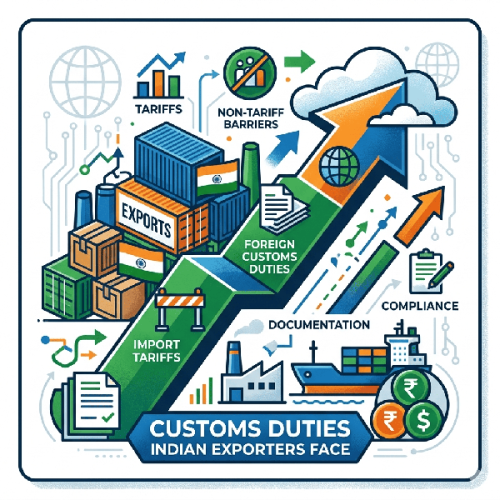
For Indian exporters in 2026, the landscape regarding customs duties is a blend of inward-looking costs (duties paid on imported inputs) and outward-looking opportunities (preferential access via new trade deals).
While India generally does not levy significant export duties on most goods, the "duty burden" for exporters primarily arises from the cost of importing raw materials and components required to manufacture finished goods for the global market.
1. The Core "Duty Burden" for Exporters
The primary challenge is not a tax on the export itself, but the landed cost of imported inputs. If you import parts or raw materials to manufacture goods, you must pay Basic Customs Duty (BCD), Social Welfare Surcharges, and IGST at the border.
-
Impact on Competitiveness: These duties increase your initial production costs. If you cannot offset these costs, your final product becomes more expensive, potentially pricing you out of competitive global markets.
-
Cash Flow Pressure: You must pay these duties upfront, which ties up working capital until the goods are exported and the refunds/rebates are processed.
2. Mechanisms to Offset These Costs
To stay competitive, the government provides several "duty neutralisation" mechanisms:
-
Duty Drawback Scheme: This is your primary tool. It allows you to claim a refund on the customs and excise duties paid on imported or domestically sourced inputs used in the manufacture of your exported goods.
-
All Industry Rate (AIR): A standardized refund percentage (easier to claim).
-
Brand Rate: Tailored specifically to your actual duty incidence (more complex but accurate).
-
Import Duty Exemptions: The Union Budget 2026-27 introduced specific exemptions to lower costs, such as:
-
Duty-free imports of specified inputs for seafood exports (limit increased from 1% to 3%).
-
Extension of duty-free import benefits for leather/synthetic footwear to shoe uppers.
-
Exemptions for capital goods used in sectors like Lithium-Ion cell manufacturing and aircraft MRO (Maintenance, Repair, and Overhaul).
3. Navigating Global Markets (Preferential Access)
India has recently finalized significant trade agreements with the US, EU, and UK. These are critical for reducing the customs duties your customers pay when your goods arrive in their countries:
-
EU Market: Indian exporters now enjoy preferential access across roughly 97% of tariff lines. Sectors like textiles, leather, footwear, marine products, and agriculture have seen duties slashed, often to zero, providing a massive competitive edge.
-
US Market: The interim bilateral agreement focuses on tariff reductions for high-value sectors such as pharmaceuticals, gems/diamonds, and aircraft parts, reinforcing India’s role in these supply chains.
4. Operational Compliance Challenges
In 2026, many exporters still struggle with:
-
Incorrect HSN Code Classification: Misclassifying goods can lead to paying higher duties or facing severe penalties and clearance delays.
-
Documentation Complexity: Despite efforts to simplify (e.g., the reduction in mandatory shipping documents), managing certificates of origin, sanitary/phytosanitary (SPS) certificates, and compliance with foreign safety standards remains a high administrative cost

krishna
Krishna is an experienced B2B blogger specializing in creating insightful and engaging content for businesses. With a keen understanding of industry trends and a talent for translating complex concepts into relatable narratives, Krishna helps companies build their brand, connect with their audience, and drive growth through compelling storytelling and strategic communication.